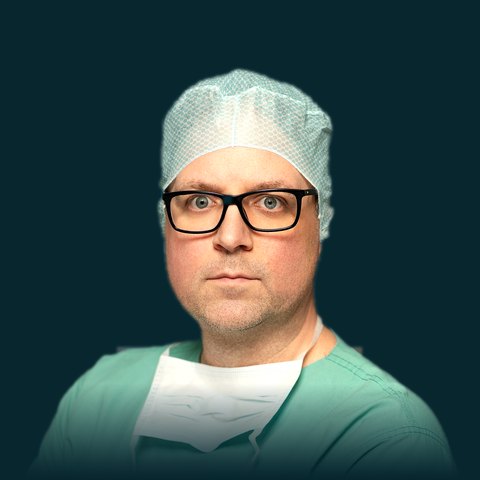
Operating days
I operate at your hospital
Agreed operating days in your theatre, with your team. Patients stay with you and the procedure happens on site — instead of a transfer that costs your hospital the case.
Specialist in Orthopaedics and Trauma Surgery
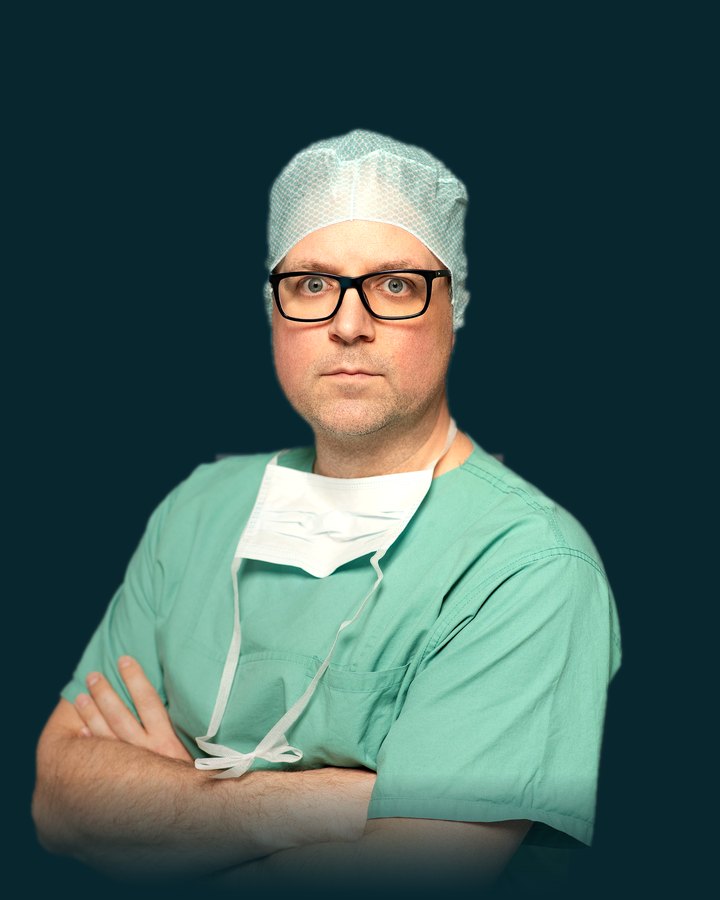
For more than 15 years I have operated on injuries, wear and malalignment — well over 10,000 procedures, and out of them grew my expertise across orthopaedics and trauma surgery. As an industrial engineer I plan every correction in detail before I make the first incision.
10,000+
Operations in more than 15 years
2,000+
Children operated on at the reference centre
20+
Hospitals I have operated in
AO Trauma
Faculty & international speaker
About
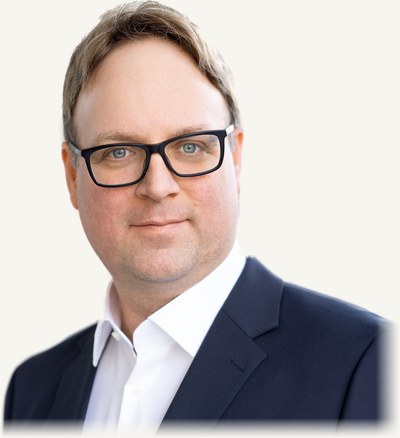
I operate, I write expert opinions, I build companies. Each role sharpens the others.
I treat the severely injured, operate on children and preserve limbs where amputation was already on the table. As an industrial engineer I also see where a process jams when the same problem keeps coming up in the OR.
turbo student
Profiled in DER SPIEGEL
Privately: at home in the Düsseldorf/Wuppertal area, happily married and father of three daughters.
Beyond the hospital
When something turns out to be a recurring problem in the clinic, I try to solve it as an entrepreneur: digital health, surgical education, outpatient care. More under Ventures & partnerships.
Clinical focus
The number of procedures says little about the individual case — the complex ones are decided in planning, not only in theatre.
I also operate on an outpatient basis: suitable fractures — for example of the distal radius, proximal humerus, clavicle, ankle or foot — as well as tendon injuries. Depending on the procedure, outpatient surgery may also be possible for children. Whether outpatient surgery is appropriate depends on the injury, the procedure and the individual situation. At the same time, my clinical work at a university level-1 trauma centre includes major trauma, complex articular and shaft fractures, open fractures and severe soft-tissue injuries.
Foot, ankle and subtalar joint: congenital and acquired deformities, post-traumatic instability, arthritis and complex multidimensional reconstructions.
Correction of complex axial malalignment, post-traumatic deformities and limb salvage in children and adults. Millimetre-accurate planning and execution using hexapod, circular fixator and rail systems with computer-assisted alignment.
Controlled lengthening by distraction osteogenesis — with fully implantable, motorised intramedullary nails or external systems. The most common reason is a leg length discrepancy after injury or a growth disorder. Bilateral lengthening for greater height is equally possible. The treatment takes months, not days; I accompany it personally and discreetly.
Where bone is missing — after infection, non-union or severe trauma — new bone has to form so that the bone bears weight along its full length again. Several procedures are available for this, among them segment transport. A related technique is transverse bone transport, which uses the same regenerative processes for chronic wounds, atrophic non-unions and perfusion disorders such as diabetic foot syndrome.
Circumscribed cartilage defects of the knee and ankle are treated joint-preserving. Depending on defect size, location and bone involvement, the options are AutoCart (autologous minced cartilage), AMIC (matrix-induced chondrogenesis) or OATS (osteochondral autograft transfer) — at the ankle frequently combined with correcting the limb axis that overloaded the cartilage in the first place.
University paediatric trauma reference centre with more than 2,000 surgical procedures in children: acute management of complex fractures and epiphyseal injuries during skeletal growth, operative correction of post-traumatic malalignment — always with an eye on growth plates and biological potential. Children are not small adults: growth forgives some things and punishes others — judging both correctly is the core of this field.
Would you like to discuss a complex finding or a possible operative approach?
Typical reasons: non-union or malunion · revision after previous surgery · axis or length deformity · infection and soft-tissue problems · an advised arthrodesis or amputation.
Make a surgical enquiryFor hospitals & colleagues
Not every hospital has routine in every indication. For exactly those cases I am available as an external surgeon — by the day, plannable, and without you creating a post.
Operating days
Agreed operating days in your theatre, with your team. Patients stay with you and the procedure happens on site — instead of a transfer that costs your hospital the case.
Proctoring
Your team operates; I am at the table and step in where needed — for whatever procedure you want to introduce: hexapod, ring fixator, rail system or motorised transport nail, longitudinal as well as transverse bone transport. I take the first steps myself and hand them over case by case until your team carries the procedure on its own. This is the format I teach as AO and Orthofix faculty.
Advisory
A second opinion for your hospital on difficult decisions, review of ongoing cases, or building up a specialty of your own — with the eye of a surgeon and that of an industrial engineer.
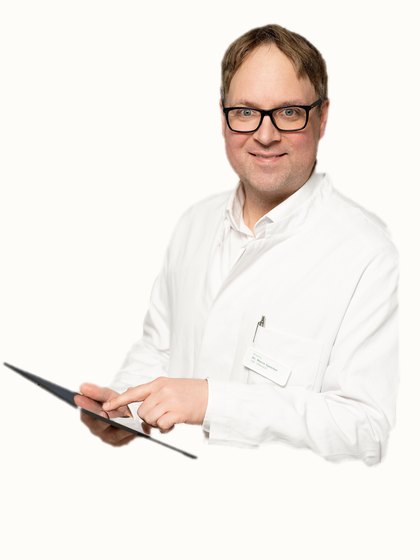
For management: every transferred case is revenue leaving the hospital and expertise that fails to grow. An external surgeon on a temporary basis costs no permanent post, does not tie up training accreditation, and keeps both in-house.
Surgical Mentoring
Holding retractors does not teach you to operate. What is missing is rarely the manual skill — it is the system behind it: why this approach, why this sequence, and what you need to know and to have prepared before you begin. That is what I pass on.
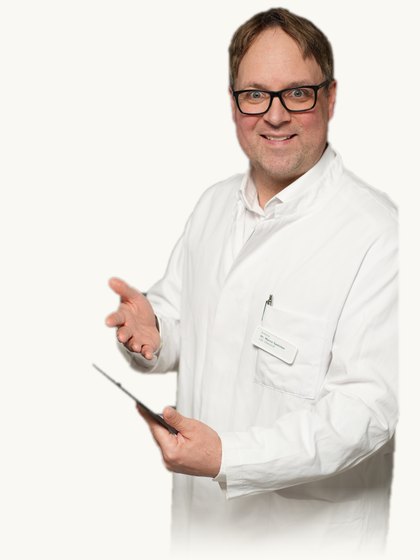
Once you understand why a step works, you no longer have to memorise it.
Webinar
The fundamentals in the order you need them in theatre: planning, approach, reduction, osteosynthesis — and the typical errors, together with the question of how to spot them early. Access stays with you after purchase: before a shift, before your first own osteosynthesis, before the board exam.
1:1 mentoring
We work through your own cases: planning, choice of approach, reduction technique — and whatever looked different in the situs than in the textbook. Appointments are arranged individually, as a single session or across a longer stretch of your training.
Expert witness
Judged ex ante: on the findings and knowledge of the time, not on today's outcome. The benchmark is the specialist standard, substantiated by the current international evidence. For courts, statutory accident insurers and insurance companies — even when the result is not what the commissioning party hoped for.
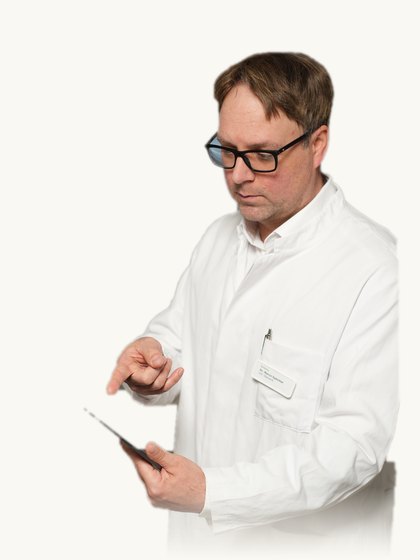
Writing expert reports changes the way you operate — you know which decision will still have to be justified years later.
Reconstruction rarely fails on craft — it fails on misjudgement. Which procedure, in which order, with how much patience.
Career
The main stages at a glance — everything else is in the CV.
Full CV (PDF, German)since 2017
Hospital with a paediatric trauma reference centre; focus on deformity correction, paediatric trauma and limb preservation.
AO Trauma · Orthofix since 2025
Instructor and speaker in international surgical education and training.
2016 · 2017 · 2018
Additional qualification in sports medicine (2017), subspecialty training in advanced trauma surgery (2018).
2003 · 2010 · 2012
Two complete degree programmes, doctorate at the University of Zurich. Detail knowledge alone was never enough for me — whoever masters only one field will only ever find the solution in that field.
Lectures, teaching & first cases
Lectures and courses for AO Trauma and Orthofix, international, plus documented first cases. A full list of contributions is available on request.
The TrueLok Evo Ring Fixator for Proximal Tibia Fractures
Bone Restoration in Proximal Tibial Osteotomy using Synthetic Bone Graft
First European case with the TrueLok Elevate
Entrepreneurial engagement
Alongside my clinical work, I am a shareholder in Key2Motion GmbH and Key2Health GmbH. They bring together my entrepreneurial work in digital health and outpatient medical care.
Digital applications and processes in healthcare.
Shareholder
Outpatient medical care and healthcare investments.
Shareholder
Individual projects will be presented when they launch publicly.
Contact
Whether second opinion, surgery, expert witness review or partnership — your message lands in my inbox, not in a secretary’s.
How a case enquiry works
Your enquiry
A short description is enough: what it is about and what has happened so far. I will tell you in the first contact which documents help.
Review & assessment
I look at findings and imaging myself and get back to you with a clear assessment — what is possible, what I recommend and what I don't.
Consultation & planning
If surgery makes sense, we plan it together in detail. If it doesn't, I will tell you just as plainly.
I will review your enquiry and respond to you personally.